All articles Team Genartml · 6 min read
AI Automation
AI agents explained: what they can actually do for an Indian business in 2026
A founder who builds AI agents explains what they are, five jobs they can do for Indian businesses today, and where they still fall short.
Team Genartml · 6 min read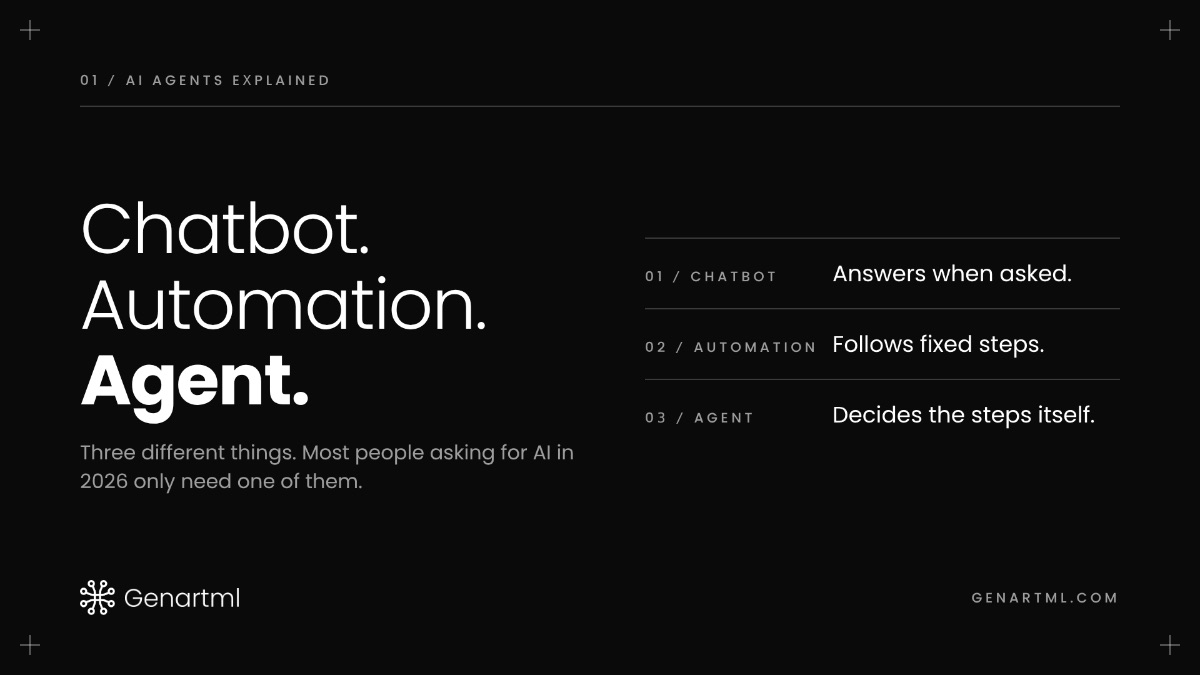
Every second message I get this year has the word "agent" in it. A distributor in Rajkot wants one. A clinic owner in Pune has heard one can replace a receptionist. A coaching institute wants one that teaches. Most of them mean different things, and most of the content online is not much help, because it is written either to scare people or to sell them something.
I run Genartml, an AI automation and software studio in Ahmedabad. We build agents for ourselves and for businesses, so I see what works and what breaks up close. This is my plain explanation of what an AI agent is, what it can do for an Indian business right now, and where you should not trust it yet.
## What an AI agent actually is
Three things get called "AI" today, and the difference matters.
A **chatbot** answers questions. You type, it replies. It does not do anything after the conversation ends.
An **automation** follows fixed steps. When a form is filled, send this email, add this row, notify this person. It is reliable, but it cannot handle anything it was not told about in advance.
An **AI agent** is given a goal, a set of tools and some rules, and it decides the steps itself. It can read a message, work out what the person needs, look something up, fill a form in your software, send a reply, and pass the case to a person when it is unsure. The language model is the brain. The tools are its hands: your sheet, your CRM, WhatsApp, the phone line, your accounting software.
A simple test: if the software has to decide what to do next, based on what just happened, it is an agent. If it only follows a script, it is automation. Both are useful. Many good systems are mostly automation with an agent at the one step that needs judgement.
## Why 2026 is different from 2023
Three years ago, the models could write well but could not be trusted to act. Three things have changed since.
First, models now use tools reliably. They can call an API, read the result and decide the next step, many times in a row, without losing track.
Second, voice got good. An agent can now hold a phone conversation with low enough delay that it feels like a conversation, and it can follow someone who switches between Hindi and English mid-sentence. For India, that is the real shift, because a large share of business here still happens on calls.
Third, the cost per task has dropped far enough that a small business can run an agent on real work every day, not just in a demo.
## Five things an agent can do for an Indian business today
These are jobs we either run ourselves or can build today. I have kept them concrete.
**1. Talk on the phone, in the language your customer speaks.** We built a voice agent called Cortina. It speaks on the phone, says up front that it is an AI assistant, asks one question at a time, and books a call with our team when the conversation needs a person. It also follows strict rules: it never quotes a price, never promises a date and never makes up a fact it was not given. That last part is the hard engineering. Making an agent talk is easy now. Making it stay inside its rules on every call is the actual work. **[Daksh: add one line on what Cortiva has handled so far, if you want a number here.]**
**2. Read documents so nobody has to type them.** Invoices, GST bills, purchase orders, delivery challans, KYC forms, resumes. An agent can read the PDF or the WhatsApp photo, pull out the fields, check them against what it expects, and put them into Excel, Tally or your own software. When something does not match, like a GSTIN in the wrong format or a total that does not add up, it flags it instead of guessing. For a trading business that processes hundreds of bills a month, this is hours of data entry back every day.
**3. Answer from your own information, on WhatsApp or your website.** An assistant like ChatGPT, but one that only answers from your price list, policies, product sheets and past answers. Your customer asks about stock, delivery areas or warranty on WhatsApp at 11pm and gets a correct reply. When the question is outside what it knows, it says so and hands over to your team. This is the use case I see working best right now, because the information is yours and the scope is clear.
**4. Run the back office reports you never have time for.** We built Mainline, our internal software suite for payroll, project tracking, finance and KPIs. Running our own company on it taught me that the most useful agent is often the boring one. An agent can pull numbers from your systems each morning, compare them with last week, and send the owner a short note: collections are behind, this project is slipping, this expense doubled. It does not replace your accountant. It makes sure you see the problem on day two, not at month end. **[Daksh: confirm which Mainline tools use AI today, so this paragraph stays accurate.]**
**5. Teach and test at the student's pace.** We also build education products: Evoluter for UPSC aspirants, which is live, and Extuter for JEE and NEET students. Education is where agents may change the most in India, because one good teacher cannot sit with every student. An agent can explain a concept again in simpler words, set the next question based on the last mistake, and show a mentor which students are falling behind. **[Daksh: confirm whether Evoluter or Extuter use AI in this way today. If not, keep this as what is possible.]**
## Where agents still fall short
I would rather you hear the limits from me than discover them after you have paid for something.
- **They make mistakes with confidence.** An agent can give a wrong answer in a very sure tone. Every agent we build answers only from approved information and hands over to a person when unsure. If someone sells you an agent with no handover, walk away. - **Indian languages are uneven.** English, Hindi and Hinglish work well. Other Indian languages, strong regional accents and noisy lines are improving but are not equally reliable yet. Test with your real customers before you commit. - **Old software is the real bottleneck.** The agent is only as useful as the systems it can reach. If your data lives in a register, a desktop app with no connection, or one person's head, that has to be fixed first. - **They cost money to run.** Phone minutes, WhatsApp messages and model usage are charged per use. It is usually small, but it is not zero, and you should know the number before you start. - **Your data needs care.** Customer data handled by an agent falls under India's Digital Personal Data Protection Act. Know where your data is stored and which AI providers see it.
## How to start without wasting money
Pick one job. Not "AI for the whole business", one job that is repetitive, happens every day and has a clear right answer. Write down how a person does it today, step by step. That document is half the agent. Then build a small version, run it next to the person for two weeks, and compare.
If it works, expand. If it does not, you have lost very little, and you have learnt what your business actually needs.
## Where Genartml fits
We build AI agents, automation and custom software for businesses, on a fixed price and a fixed timeline agreed before we start, and I review every project myself. If you have one job in mind that you think an agent could take off your team, write to me at **[Daksh: daksh@genartml.com]** or visit genartml.com. I will tell you honestly whether an agent is the right answer, or whether plain software would do it better.